Read part one of my Who Wants to Be a Millionaire saga here.
“Welcome to Millionaire!” Meredith Vieira said. “At just twenty-three-years-old, today’s contestant grew up on Millionaire and is now living a dream by being here today. From Harrisburg, Pennsylvania, please welcome Kristen VanBlargan!” I walked over to the lectern, glancing at the shadowed figures of the audience members. Among their gawking faces, I spotted my parents, who gave me a thumbs up.
On the screen, ten categories briefly appeared in their original order of difficulty before shuffling randomly.
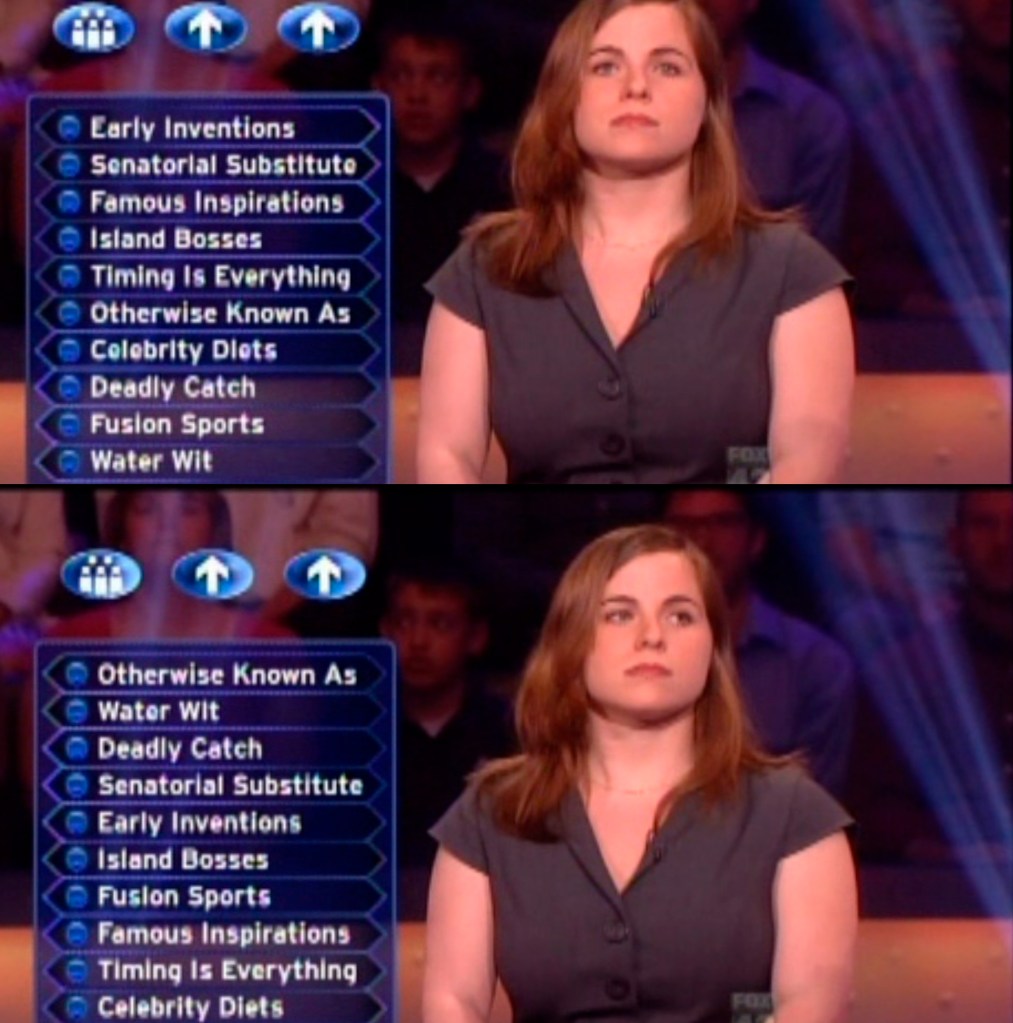
My first question was on Celebrity Diets:
Reportedly used by Kelly Clarkson and Mandy Moore, what fad diet created by Dr. Sanford Siegal curbs hunger with a sweet treat?
Before the choices came up, I knew it was the Cookie Diet. “I think I know the answer,” I said, my voice trembling. But I looked at the screen again: all four choices were real diets. I thought of the article The Patriot-News had run about me that morning. Everyone I knew would read the article, would learn of my gossamer dreams, would watch the show when it aired. And they would see me blow my first question.
“But I’m so nervous and I don’t want to get the first question wrong,” I said. “I’m just going to ask the audience to be sure.” I immediately regretted my decision to waste a lifeline. 49% voted for the Cookie Diet, so I locked in my answer. It ended up being worth the lowest possible amount: $100.

After banking $5,000 for a math question, I tackled Famous Inspirations:
A theory emerged in 2011 that what famous painting was actually inspired by the artist’s male apprentice?
A. Whistler’s Mother B. Girl with a Pearl Earring C. The Birth of Venus D. Mona Lisa.
Great, I knew art. “It’s definitely not Girl with a Pearl Earring or Whistler’s Mother,” I said. That left Botticelli and Leonardo. The Birth of Venus was a female nude, so it seemed unlikely, and I knew there was speculation about the model in the Mona Lisa. But I had never heard this particular rumor, so I played it safe and I skipped the question.
It was indeed the Mona Lisa, and I missed out on $7,000.
I breezed through a gimme on fusion sports and a more difficult question about Captain Henry Morgan. But these added only $1,000 and $500 to my bank, respectively.
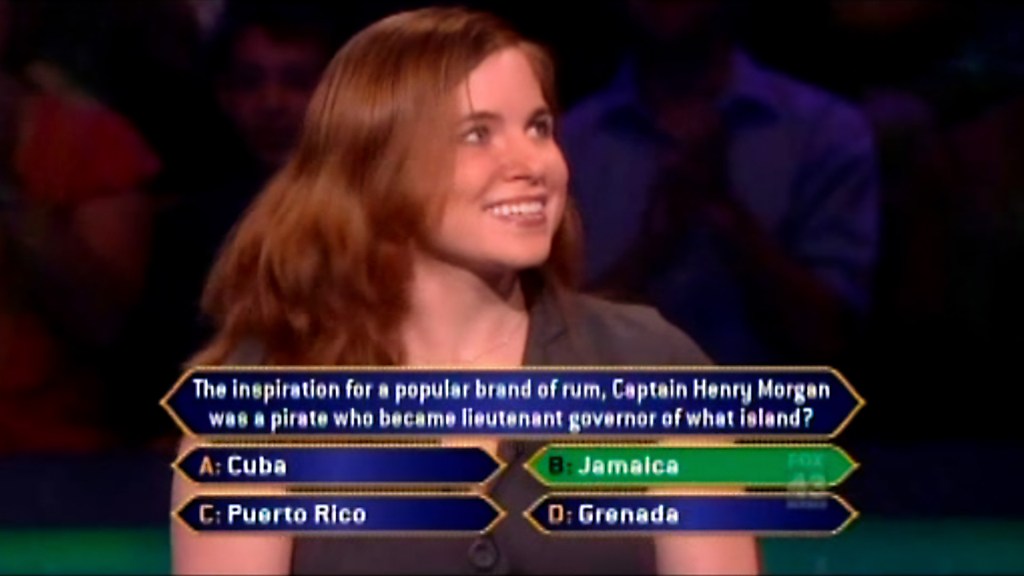
Then came the hardest question in the round:
“In 1979, Bill Moggridge designed the Grid Compass, an early version of what?”
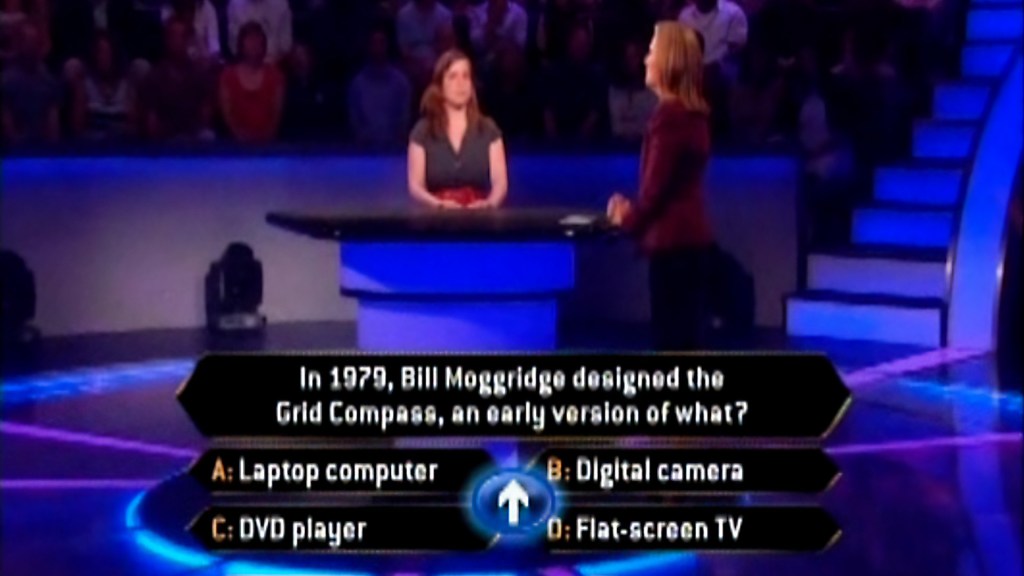
I eliminated DVD player but otherwise had no idea, so I skipped it. I had burned through my lifelines, but all the biggest money amounts ($25K, $15K, and $10K) and three of the easiest questions remained on the board. I had a 1-in-4 chance of getting a no-brainer for my next question.
Instead, I got the second-hardest question:
What is the name of the Illinois politician appointed by Gov. Rod Blagojevich to complete Obama’s Senate term?
I remembered the scandal. I could picture the senator. So I was hopeful I would recognize his name when the choices appeared: Marvin Harris, Logan Morris, Clayton Ferris, Roland Burris.
But I didn’t.
My bank—$6,600—was nearly as low as it could’ve been by question seven. If I got it right, I was all but guaranteed to make it to the second round and win at least $50,000. If I walked away, I would leave with just $3,300—barely more than the $1,000 consolation prize. I needed to guess.

I guessed wrong.
I chose Marvin Harris, a name that sounded familiar. (As I later learned, he was an anthropologist who wrote an article I read in college.) Even before I uttered “final answer,” I heard audience members groan.
“I did horribly,” I said, shaking my head when “Roland Burris” flashed on screen.
“Don’t feel bad. You tried,” Meredith said, grabbing my hands and kissing my cheek. “All you can do is try.”
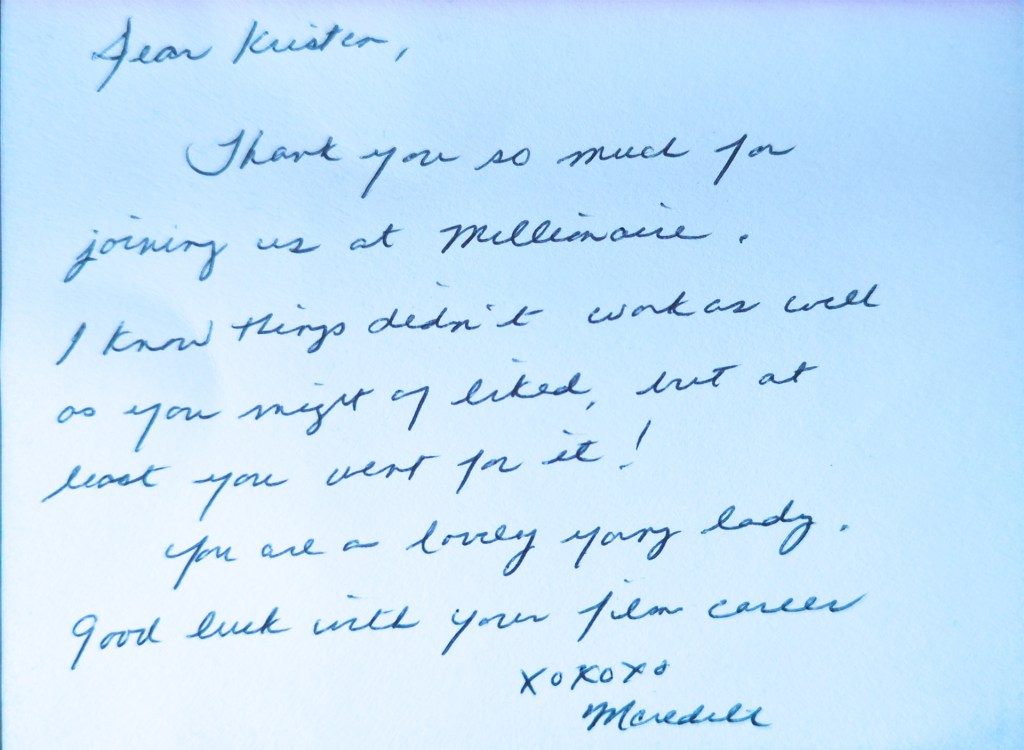
A week later, Tropical Storm Lee inundated the Susquehanna, which swelled to twenty-seven feet. Ten thousand residents fled their homes, two bison drowned in the Hershey Park Zoo, and half a foot of water seeped into the basement of my parents’ home.
I had been staying with my aunt in Virginia while interviewing for jobs, but I returned to Harrisburg to help with the house. Driving through my flooded neighborhood, I rear-ended a Lexus and wrecked my Hyundai. My $1,000 consolation prize went straight to salvaging my car.
After the article about my upcoming episode ran in The Patriot News, the manager of a local assisted living facility reached out to me. “The residents are huge fans of Who Wants to Be a Millionaire,” he said. “We’d love for you to watch your episode with us.” Who wouldn’t want to view their failed game show appearance surrounded by cheerful grandmothers?
Flanked by coverage of the flood and commercials for antidepressants, my episode aired on October 4. As the room of octogenarians watched me walk onto stage, one blurted out, “She looks chubby!” Having long since parted ways with their filters, the residents continued to talk about me as if I weren’t in the room. When I lost, an elderly woman suggested that I “should’ve tried out for The Bachelor instead.” At the end of my run—edited down to a scant eight minutes—the manager had me stand up.
“As you can see, Kristen is proof that the camera adds ten pounds.”
I spent the rest of the day fielding Facebook messages from strange men and reading online commentary.
On a bygone blog: I really question their casting choices lately.
On a fan forum: Her poor parents. Their kid gets a shot they never had and an event that was of national news (when she probably would have been paying some attention) stops her cold.
On Twitter: This chick looks like Amanda Knox.
I recounted my woes while getting lunch with a college friend. “I’m sorry about the creepy messages,” he said. “But it might be for the best that you didn’t win a million dollars. Maybe you would’ve regretted it.”
“I’m pretty sure more money wouldn’t make my life worse.”
“My childhood best friend won the lottery in college,” he said. “He dropped out of school, moved to Los Angeles, and spent his nights hopping from one club to the next.”
“Sounds like fun.”
“He died of a heroin overdose the week after he got to L.A.”
“Jesus.”
“I’m not saying you would’ve died. But you’ll be more motivated to chase your dreams without the money to fall back on.”
Two months later, I saw a listing for my dream job as a video editor. The posting had been up for several weeks, but I poured my heart into the cover letter, hoping the position hadn’t been filled: “After attempting—and subsequently failing—to write The Great American Novel and making an ill-fated appearance on Who Wants to Be a Millionaire?, I have decided to return to my first love: filmmaking.”
I later found out that they were about to offer the job to someone else when they saw my cover letter in the inbox. The CEO, a fan of Millionaire, invited me to an interview.
I didn’t get a million dollars, but I got the job.


 Kristen VanBloggin’
Leave a reply to Vince Casella Cancel reply