When most people get The Call from Jeopardy!, they spend the next six weeks cramming. They memorize Best Picture winners, potent potable ingredients, and presidential terms.
This may, at best, net you a few extra thousand dollars. To even get on Jeopardy!, you have to pass two written tests and ace an audition. You already virtually know everything. The likelihood that the 61 clues on a given episode will consist of the new knowledge you’ve acquired is small. For every one clue about the composer of Pagliacci, there will be ten that no amount of studying can help you with. Rhyme Time. Adjectives that begin with “p.” Final Jeopardy questions that rely more on lateral thinking than actual knowledge.
And the Juilliard music professor on your left might beat you to Leoncavallo anyway.
My call from the Jeopardy! staff in December 2024 came at the end of one of the hardest years of my life, marked by a painful divorce, a long-distance move, and a series of job interviews that led nowhere. Things were finally looking up.
“Tell only the people that need to know,” the contestant coordinator instructed me. Initially, I told only the three people I invited to the taping: my boyfriend, my twin sister, and Jeff.
“Here’s the thing: the stuff you’re less good at is the stuff that you’re not going to get good at with a few weeks of prep (e.g., sports, the pop culture that doesn’t interest you),” Jeff texted me. “You should focus on two things and two things only: getting buzzer practice in and wagering.”
I ignored his advice and immediately started making flashcards. I stocked up on reference books and created a study plan. I treated it like a full-time job, tackling a different set of topics each day. One day I carded parts of teeth, World War II battles, outlaws, and Charles Dickens characters. The next day I pored over lists of mountain ranges, Civil War generals, and famous ships. All told, I created several thousand flashcards. I watched old episodes of Jeopardy! and pretended to buzz in with a click pen, the method championed by Ken Jennings. I tracked my Coyrat on J! Scorer, where I averaged a respectable 43.22 clues correct per game.
While I was home for the holidays at the end of December, Jeff invited me to play a series of simulated Jeopardy! games with our friend Bill, who had set up a mock game system in his basement. Bill first gave me tips about where to find the Daily Doubles: they are most often in academic categories like history, science, geography, literature, and to a lesser extent, the arts. They’re more rarely in wordplay or pop culture and almost never in video clues.
He also gave wagering advice. If you find a Daily Double in the first round, you should always bet the maximum regardless of your score. The same applies to the early stages of the Double Jeopardy round. Even if you miss, there’s still so much money on the board that it’s worth the risk. “There’s a stereotype that women wager small,” Bill said. There’s some truth in this—women are taught to be careful from a young age. “I don’t want you to get on stage and feel like you have to play it safe.”
Before playing a series of practice games against Bill and his friends, he gave me a rundown of the buzzer: after the host reads the clue, someone manually turns on a light. If you buzz in early, you are locked out for a quarter of a second. But you also don’t want to buzz in late, lest your opponents beat you to it. The key is to find the sweet spot. Bill, like many past contestants, recommended relying on sound rather than the light.
After I buzzed in, Bill told me my speed, and I was frequently too slow or too fast. I did well on Final Jeopardy, but as Bill told me, “You don’t want Final Jeopardy to matter.” It’s more important to keep control of the board, find the Daily Doubles, and bet wisely on them.
In one of our games, I groaned after a triple stumper about “fleshy, creeping underground stems.” I wasn’t confident enough to answer rhizomes. “Are you playing to win?” Bill asked. “Then you need to buzz in if you think you might know it.” This is good advice: more often than not, your gut instincts are correct. But it’s easier said than done.
Seeing my struggles on the buzzer, Bill had me play a game where I acted as Jeff’s buzzer ventriloquist—buzzing in on every clue but letting Jeff answer. It became clear that my problem wasn’t that I was slow. Mastering the buzzer required not only speed but also confidence and quick processing time.
In the last game, I was trailing when I found the final Daily Double late in the game. The category was physics, my worst subject in high school. I hesitated. “Can you win if you bet low?” Bill asked.
“Probably not,” I admitted.
“Then you have to go all in.” I did, and the clue turned out to be a gimme:

“That’s barely physics,” I said, rolling my eyes. “It’s a straightforward etymology question.”
Bill nodded. “Don’t pay attention to the Daily Double category when you wager. The clues are often tangential to the category. You know a lot, and you need to bet on yourself.”
After eight games, I had improved, but it was clear that Jeff was right: I needed to get better at the buzzer. So I forked over $75 for a USB buzzer from Delcom. I also ordered a copy of The Secrets of the Buzzer by Fritz Holznagel and used his site to practice.
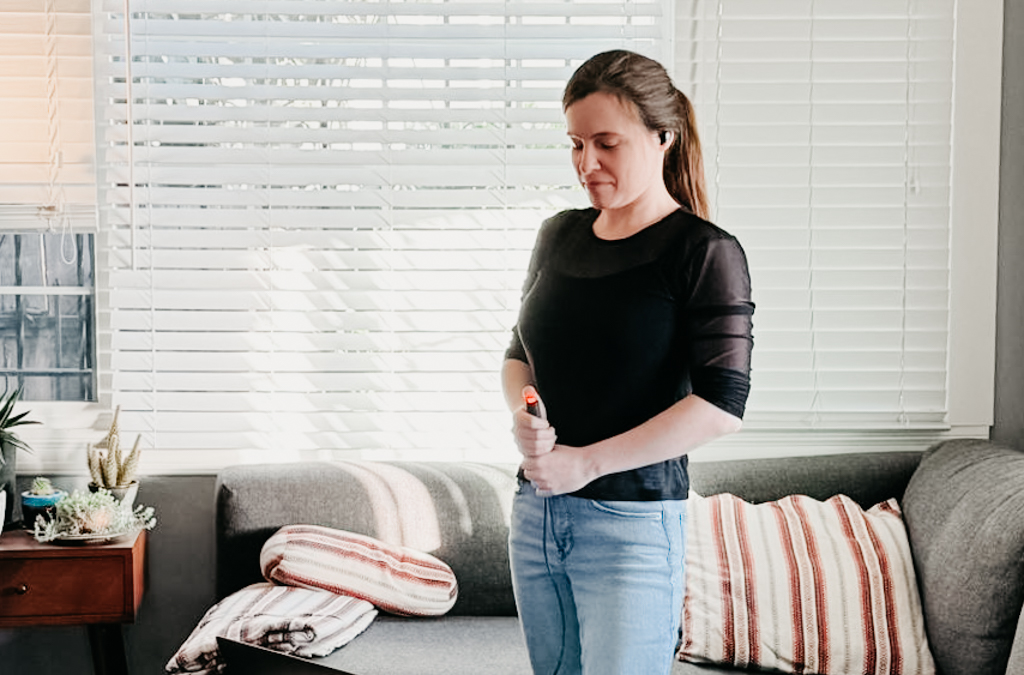
I experimented with various techniques holding the buzzer. I’m ambidextrous, and I found that I was faster when I held the buzzer in my left hand. My fastest stance was resting my hands on a lectern, but I knew that shorter contestants were raised up on a platform. Being just shy of 5’2”, I couldn’t rely on this method, so instead I held the buzzer in my left hand and put my hand on my hip—my power stance. Although Holznagel recommends going by the light rather than sound, I was considerably slower when I did this. (Women have slower visual reaction times than men, and I needed every edge I could get.)
Meanwhile, I studied Final Jeopardy wagering strategies with the help of my math professor sister. I also spoke to my friend Genevieve, who had appeared on the show in 2009 and helped her husband prepare for his own appearance in 2023. She shared tips for staying grounded, recommending strategies from The 5 Resets. Genevieve talked about how missing a Daily Double in the first round rattled her (though going all-in was the right move), and how she learned from the experience to win $330,000 on The Chase. Having choked on my previous game show appearance, I knew staying calm under pressure would be paramount.
A week before leaving for Los Angeles, I selected outfit options using the wardrobe department’s detailed guidelines. I nixed one dress because it wasn’t sturdy enough to hold a mic pack, another because its pattern was too busy, and a third because it was too low-cut. (This wasn’t one of the guidelines, but I didn’t want to draw unwanted attention to my bosom.)
In total, I packed two dresses, four blazers, six shirts, two skirts, one pair of pants, three necklaces, and four sets of earrings. For shoes, I opted for black velvet flats from Birdies: comfortable but dressy enough to go with my outfit options. Although my shoes wouldn’t be visible on camera, I still wanted to feel put together.
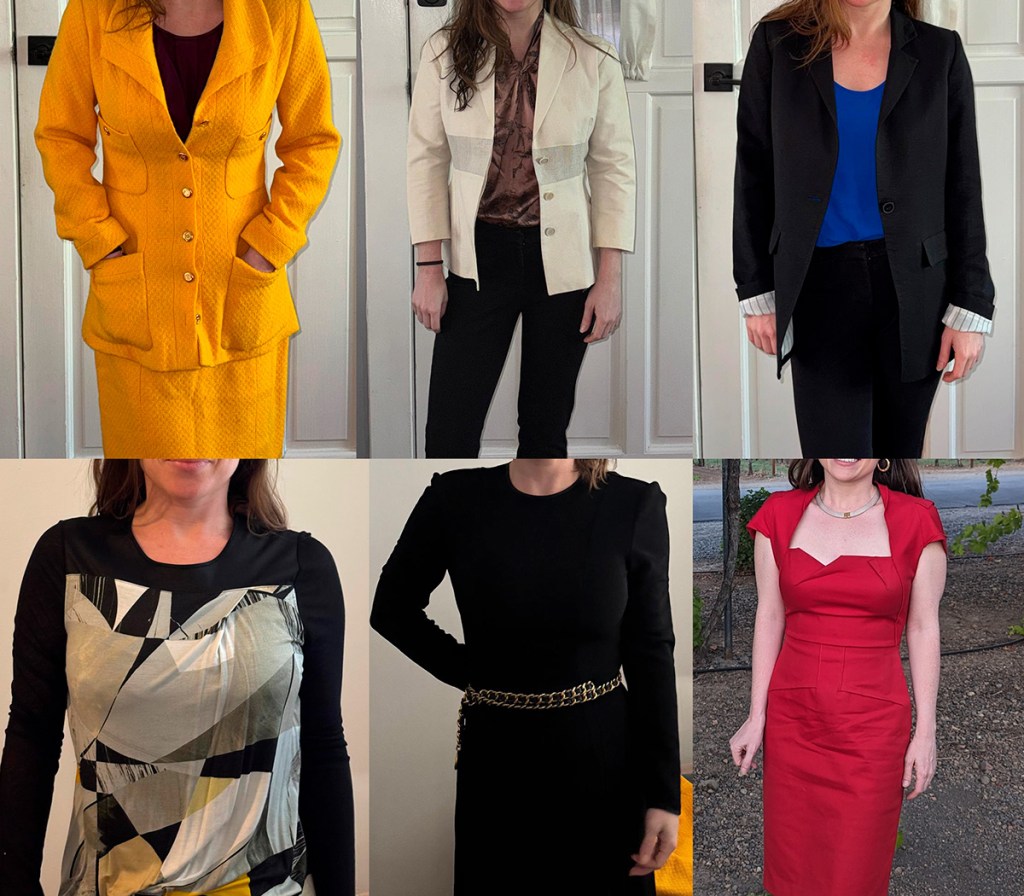
Was the plethora of clothes overkill? Maybe. But I also felt good about my chances: surely no one had spent as much time preparing. And if I wanted to win, I needed a champion’s mindset.
Continued in my next post.

 Kristen VanBloggin’
Leave a comment